1910 – 1924
Kilmainham Gaol stopped taking ordinary prisoners in 1910, but the building was far from finished. Over the following fourteen years it was opened and closed repeatedly to hold the political prisoners produced by the Easter Rising, the War of Independence and the Civil War. It is this short, intense period that gave the Gaol its place in Irish memory.
1910
Kilmainham Gaol ceases to operate as an ordinary civilian prison and the building is largely emptied.
1916
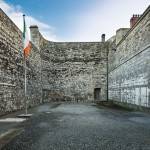
Reopened after the Easter Rising to hold hundreds of prisoners. Fourteen leaders of the Rising are executed by firing squad in the Stonebreakers' Yard in May.
1919–21
Used during the War of Independence for republican prisoners. In 1921 men imprisoned after the burning of the Custom House smuggle in a camera and photograph life inside the Gaol.
1921
Ernie O'Malley, Simon Donnelly and Frank Teeling escape from the West Wing. The remaining prisoners are released in December following the Anglo-Irish Treaty.
1922–23
During the Civil War the Gaol holds anti-Treaty prisoners, including hundreds of women. Four young men — James Fisher, Richard Twohig, Peter Cassidy and John Gaffney — are executed here on 17 November 1922.
1924
The last prisoners leave Kilmainham Gaol. The building is formally closed by order in 1929.
Prisoner registers for these years have not survived, so the museum has built up lists of political prisoners from many different sources — none of them complete. The archive is particularly strong on the experience of rank-and-file members of the Irish Volunteers and the Irish Republican Army, and on the women imprisoned here during the Civil War.